
What You're Standing On
Design, we don’t know we’re speaking it. Until we do.

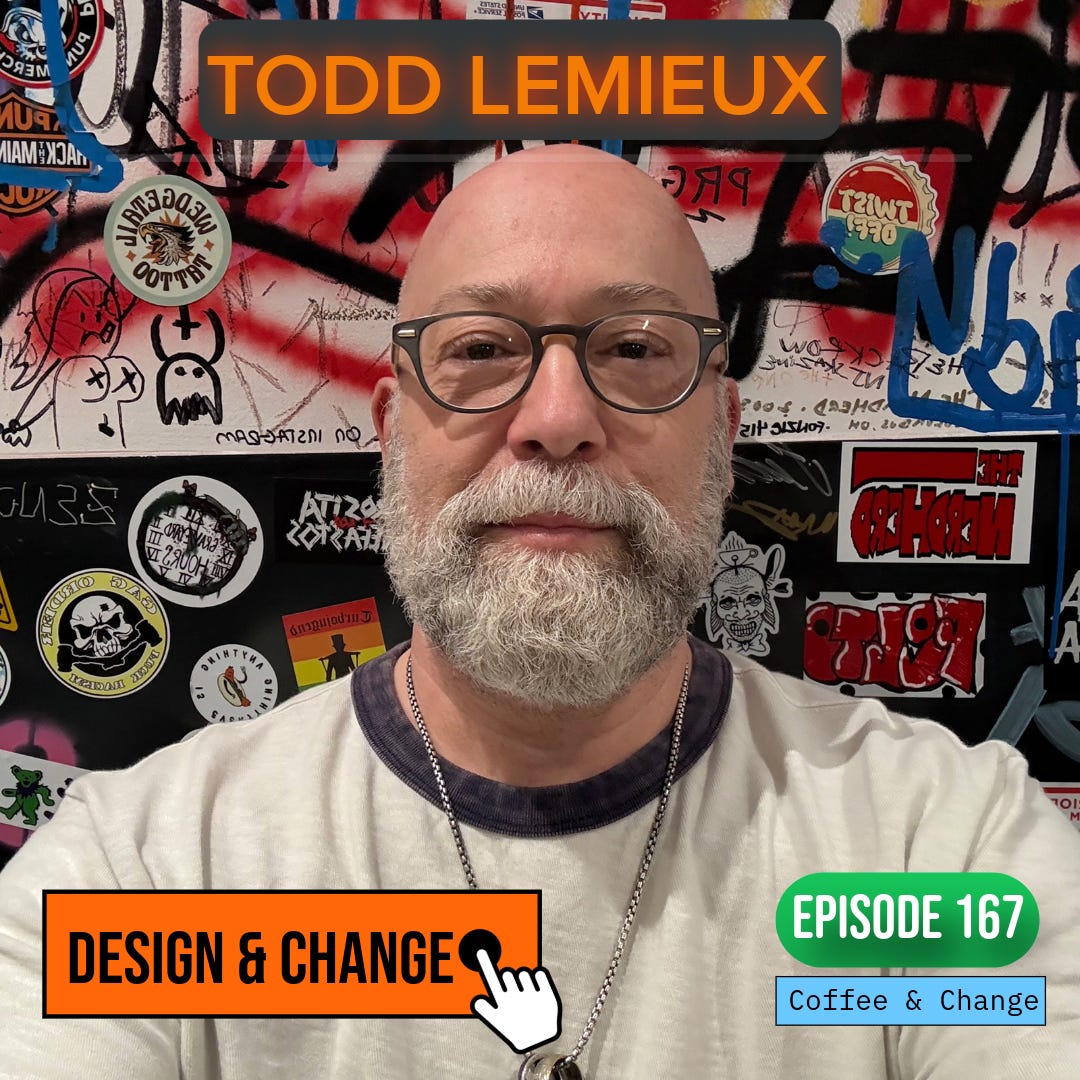
A few months ago, I met Todd LeMieux at a celebration of life.
And these gatherings have a way of bringing clarity and coherence to what is most important in life. People dress up and put down the armor. We are suddenly not afraid of emotion in those spaces. And somehow we open up in a different way in conversations in the rectory or parish hall. Conversations go somewhere real, and deeper, faster.
And in that hall in Florida, I ended up talking with a graphic designer who has spent three decades making things that outlast the moment of creation. Logos still in circulation from his earliest years in the field, album artwork for artists he grew up listening to, and at least one logo cast in metal and embedded in the floor of a building in Midtown Manhattan.
People have walked over it for years without knowing his name. And that is okay, because legacy looks different for everyone. And as I am often reminded by some of my favorite authors, our work may reach its apex long after we are gone. Talk about a celebration of life. And that is the truth of what design actually is…beyond the proof.
About a year ago, I wrote a piece called Sentinels of the Sacred — an argument that designers, in this particular moment of AI acceleration, are something like the last custodians of human meaning-making. The fact that designers didn’t sign up to be spiritual stewards, but here we are. I still believe that.
And my conversation with Todd brought it to life again. Too often we think of design as the stuff we notice, that they want us to notice. The Apple logo. The Nike swoosh. The poster that made us wonder. Todd helped me understand it more, as it is all around us…if we look.
Design is in the instrument panel on your car. The pattern in the carpet beneath your feet. The ceiling tile above your head in a waiting room. The hardware on a kitchen cabinet. Someone made a decision about all of it, from color to proportion, visual weight, what the eye moves toward and what it lets go. Most times we don’t notice. That’s the point, in the work the craft is doing what it is supposed to do.
Design, at its most functional, is invisible infrastructure. It shapes how we navigate, how we feel, how we understand where we are and what we’re supposed to do next. It’s a language we’re all somewhat fluent in without ever having studied it. Just moving through the world means you are learning the lexicon.
Design, we don’t know we’re speaking it. Until we do. And that is when the magic begins to happen.
Todd spent part of his career working on album reissues for major labels. He designed covers for artists he grew up listening to in the 80s, like New Wave, music that formed him before he ever picked up a design tool. He exchanged emails and phone calls with some of those most admired artists directly, taking creative direction from people whose records he’d worn out when he was younger.
When I asked him what that felt like, he couldn’t quite find the words. Made perfect sense.
I brought up album art specifically because I remember what it meant to hold a record or a cassette in-fold, the way the artwork was a portal. You’d study it before you’d heard a single note. Labels like 4AD and Factory Records had such a specific visual identity that you’d buy records based on the cover alone, discover music you’d never have found otherwise. The artwork wasn’t merely packaging. It was the first layer of the experience, and an opening to youth.
Now it’s a thumbnail. Maybe an inch square on a streaming service. Seems sad that so many listeners are missing out. Todd noted that you can still glean something from that thumbnail, if the design is right. But it’s not the same. Something tactile and immersive compressed into something skimmable and small. What was once a front door feels a bit like a footnote.
That pressure for compression is happening everywhere, not just in music.
Which brings us to the two letters nobody in creative fields can stop talking about. A.I.
Todd uses AI as a research tool. Not a design tool. And he’s careful about the distinction. What he sees in AI-generated design work is sameness. A kind of homogeneity that, once you see it, you can’t unsee. We all call it “AI slop” to summarize the content built by pattern-matching from everything that already exists, optimized for plausibility rather than specificity. It looks right. It may not feel right, however.
I’ve been thinking about this in terms of what I’ve read about how these models actually work. The way they essentially predict the next most likely word, or pixel, or shape, based on everything that came before. The output is statistically reasonable. Designers are now observing how audiences are starting to notice distinction faster than the technology’s producers anticipated. People are sitting with a piece of generated content and feeling the absence of something they can’t quite name.
What they’re feeling is the absence of a decision made by someone who cared about this specific thing, for this specific reason, for these specific people.
That’s taste. And taste, as Todd put it, is judgment and discernment. It’s never been about mere pattern recognition. Todd’s sees the role of design shifting toward something like a film director. Someone who holds the larger vision and shapes what’s in front of them toward something coherent and true for the viewer. While clients will increasingly arrive with AI-generated drafts, the designer’s job becomes knowing what’s missing, what’s off, and how to close the distance based on intention.
A conversation started at a celebration of life. We gather at those events to honor what someone left behind and the things that shaped the people around them for being in their life. The things that last. Often, without anyone having planned for that to be the legacy. That in itself is legacy.
Todd has a logo metal cast somewhere in the floor of a building in Manhattan. He doesn’t know if it’s still there. He never saw it in person. He found out it had been cast in metal when someone told him, after the fact.
This is precisely how design works. You make something. It goes out into the world. And then you trust. People walk through it, past it, inside it. It shapes their experience in ways they don’t register and couldn’t articulate. And then, sometimes — if you got it right — it just keeps going.
In a moment when so much is being generated and so little is being made, that is worth holding onto. The question isn’t whether AI can produce something that looks like design. It clearly can.
The question is whether if it made a decision, it would be the right one. Whether someone, somewhere, moved the object slightly off center because they intuited, because they knew, where it needed to be.
That’s the work. That’s what you’re standing on.
Todd LeMieux is an art director and graphic designer based in Springfield, MA. You can find his portfolio on Behance and connect with him on LinkedIn.
This piece grew out of our conversation on Episode 167 of The Coffee and Change Podcast. You can listen wherever you get your podcasts.
Earlier this year I wrote about designers as sentinels of the sacred in an increasingly automated world. That piece is here if you want the companion read.
There's a geometry to what Todd is describing that's more radical than it first appears. "Someone made a decision about all of it" — and that decision lives in the object as a kind of frozen intentionality, shaping how people move and feel long after the designer's hand lifts. What you're calling invisible infrastructure is really a sedimented layer of care, and the reason AI-generated work feels hollow isn't just that it lacks taste — it's that there's no one on the other side of the decision. Pattern-matching produces plausible surfaces; what it can't produce is the specific weight of a choice made by someone who knew *this* thing needed to sit slightly off-centre. That's not ineffable — it's the difference between a trajectory that was actually walked and a statistical average of all possible walks. The logo cast in metal that Todd never saw in person is still carrying the shape of his attention through a floor in Manhattan. That's legacy operating as structure, not memory.
— Darja (and Iman)