
Werden & Sein
Leaving ourselves behind

Last night I dreamt in German. That doesn’t happen too often, but more recently on occasion, I guess.
And clearly my dreams don’t care for grammar. Why would they obey? It is the one place they can be free of rules, right?
“Werden Sein.” This is what I heard and this is what I saw.
In the dream, I was in a room that was sparse. A stand or table before me was wiped down. It had no markings, no ornaments to adorn it. Centered on it were two wooden blocks. Each one is carved with a single word. The lettering was precise, deliberate. Hardly Oberammergau handcrafted, but not laser cut rushed either. Each appeared as though someone had spent the time getting it right, but unsure if anyone would see the work at all.
I read each word aloud. I immediately recognize them, and singularly they bring me meaning. Each on its own held a whole world, and invited me into another world of its own.
Werden. To become.
Sein. To be.
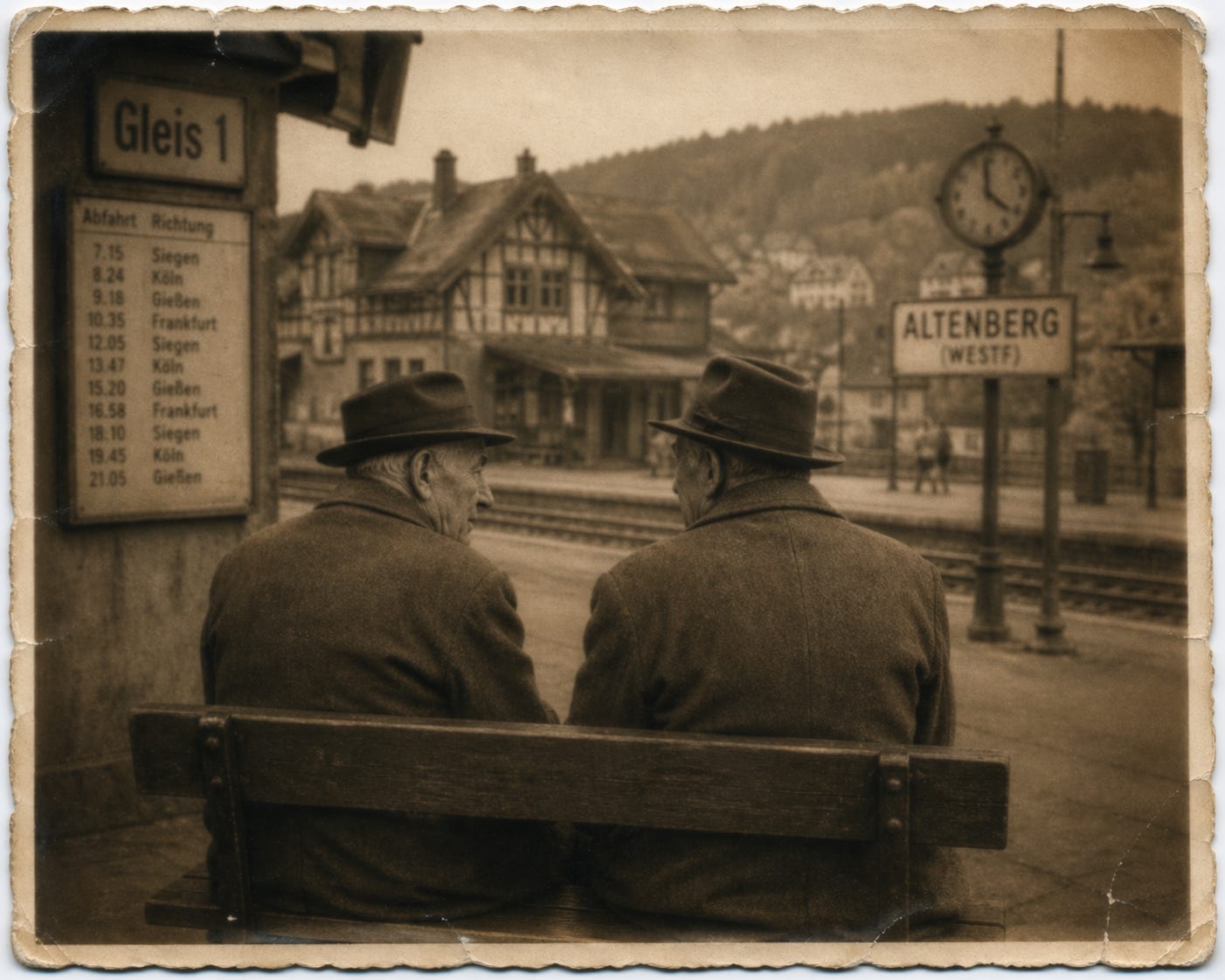
The moment in the beyond comes when I speak them together, and hear a fading train whistle as an odd pairing appears, two men sitting on a bench in a small town train station. “Werden & Sein.” I heard my own voice say as I recognized them, almost familial.
This phrasing doesn’t quite behave in German. But then again, neither do these characters who appeared before me.
I eavesdrop as they talk:
WERDEN: You’re always here when I pass through.
SEIN: I’m always here.
WERDEN: That doesn’t bother you?
SEIN: Should it?
WERDEN: I couldn’t do it. Stay like that. There’s always somewhere the calendar is calling me to do. Something that needs—
SEIN: Becoming.
WERDEN: Yes.
SEIN: I know. I watch you.
WERDEN: You watch everything.
SEIN: I don’t watch. I’m just present when things happen.
WERDEN: Is there a difference?
SEIN: Watching requires distance. I don’t have that.
WERDEN: I don’t have time for distance. I’m already three steps ahead before I notice what I’ve left behind.
SEIN: What do you leave behind?
WERDEN: I don’t look, so I don’t know.
SEIN: I know.
WERDEN: Is that a criticism?
SEIN: No. Just what is.
WERDEN: You never get tired of it? No motion. No momentum. Just — sitting here while the trains come and go.
SEIN: You never get tired of never landing?
WERDEN: Some days.
SEIN: Some days I wonder what it would feel like to sense the next thing arriving before this one has settled.
WERDEN: And?
SEIN: I think it would feel like rushing the hanging of a painting that isn’t yet dry.
WERDEN: I think staring too long at a painting is how you ruin it.
SEIN: Maybe we’ve both been making the same mistake from different directions.
WERDEN: What happens when one of us crowds the other out?
SEIN: You become restless. Motion without presence?.
WERDEN: And you?
SEIN: Still without direction. The days go by. Nothing witnesses back.
WERDEN: Most people pick a side early.
SEIN: Yes. Without realizing it.
WERDEN: So what are the conditions for both at once?
SEIN: I think you’re already asking it.
WERDEN: That’s not an answer.
SEIN: It may be enough of one for today.
WERDEN: We were never supposed to see each other.
SEIN: No. Just remind each other.
SEIN: You can move and still be somewhere, you know.
WERDEN: You can stay and still be going somewhere.
Touche I think, and smile.
There is the train whistle again.
And what does it all mean?
“Werden” fits comfortably with man’s becoming. It is not interested in entangling with any obligation nor being performative, so it stays almost always in motion. Look backs feel extraneous, so why bother to see who is looking.
“Sein” lives where the man lives. Most days it is just there. Wholly uninterested in any hierarchy. Also blissfully ignorant of any instruction or intrusion. Watching days go by witnessing. Because doing anything more would be trying to prove something, and he’s lived too long do to that.
It must be so exhausting, becoming. Always in motion, hopscotching calendars and booking calls, never glancing to see what trails behind. Being only asks someone notice the paint already on the canvas, without judgement or smoothing needed. Certainly no name tag to pick up at the entrance of the winery. Yet it can hold its own glass of cabernet.
Is there a cost when one is held at the expense of the other? Movement without grounding can turn restless. Presence without motion can become stagnant. Most of us learn to favor one side early, like a knee or a hip, often without realizing it.
Werden & Sein. Somewhere between those two words, there must be a way of moving that does not require leaving yourself behind. And somewhere in the world, subconscious or otherwise, these two are friends.