
Single Spotlight | Empty Pedestal
A short story escaped in the dreamtime

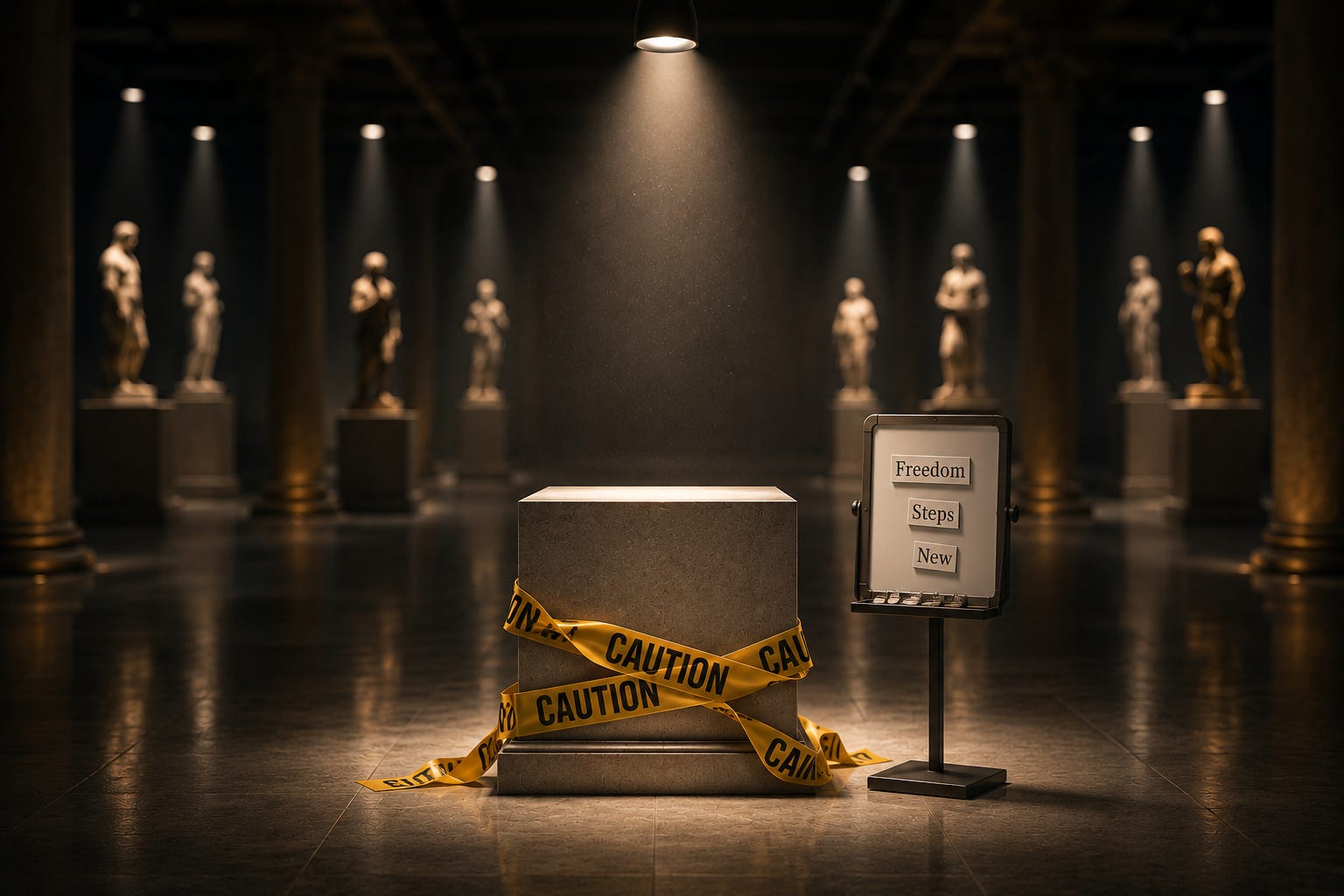
The Exhibit of Perceptual Personas was nearing its first birthday at the Metropolitan Museum of Art, and the crowds had finally begun to wane. As the summer season approached, Arthur at his security desk was looking forward to a little quiet. No more sticky-fingered school groups traipsing through his hallways. At least for a few solitary months anyway.
All the fanfare of the new exhibit curated by the Times’ one-time favorite, Josephine Sternbridge, had run its course, it seemed. There were still brochures at the desk sprinkled with quotes from luminaries and literary critics from the inaugural day and ribbon cutting. “An exquisite entree into understanding our own humanity.” & “A participatory experience that shapes how we see one another in a world rushing by us.”
The idea and concept were novel but simple. And no doubt the psilocybin-inspired afterbirth of a nepo baby on the Upper East Side. Josie, as all her friends and trust fund fans called her, wanted to branch out into the art world. Dreams of being a curator from a fashion house heiress had come and gone, it seemed. So had the coverage from the Times. Arthur couldn’t remember her once visiting her own creation and curation since its opening, when camera bulbs flashed and champagne glasses clinked. And the personas looked on.
Arthur was uneasy when the Met turned its exhibit halls into cocktail parties. It didn’t feel right, almost like a betrayal to a Veteran charged with protecting these containers of struggle, intimacy and expression. He stood guard for 23 years now, in a different uniform from the one he first served in. The overtime money was great however and he couldn’t turn down those after-hours jobs with the increasing cost of living. So, he smiled and waved a wand over socialites and benefactors as they worked their way into the museum that inaugural night.
Some sort of speech was given to unveil these 36 personas placed on pedestals under a single spotlight each. Arthur could hear every other word over the occasional laughter and applause. Something about representing the 36 shades of modern-day man and woman. All holding pose and expectation amidst unfulfilled prose and purpose.
That following Sunday, after the opening gala, a huge spread in the Times called it “Art of the Everyday Man As Captured by the Not-So-Everyday Woman.” These lifelike statuettes stood bathed in a single spotlight on a slightly elevated pedestal but still in proportion to feel relatable to the onlooker and patron.
But what seemed to capture the obsession of many a visitor was the whiteboards filled with magnetic refrigerator poetry that accompanied each persona. Their very own syllabic canvas for patrons to curate while glancing at each posed persona. It was playing on the most human element of each of us, the storylines we all believe, albeit with different endings.
The idea was said to come from Josie’s mother, once a teacher in Brooklyn, who used to leave little bluets of inspiration on the refrigerator for her daughter to read while grabbing her green juice before school. The Times featured one of Josie’s favorites in the Sunday spread: “Seen. Enough. Trying. Loving. Whole.” A puzzle placed there by a mother for a daughter to find her way back, and possibly find her voice again.
Lifestyle reporters lapped it up like kittens to spilled milk. It inspired countless mother-daughter book clubs who traveled to the Museum to make an afternoon of the exhibit and curate refrigerator poetry on whiteboards with the onlooking of strangers. Arthur watched them practically skip into the museum together. But often depart with more distance between and the occasional scowl. Therein lay the real stories.
Each night, Arthur would lock up the museum after closing hours, catching the fixed eyes and penetrative stares of the 36 personas in the exhibit. And on some mornings when he would open the wing again, he would notice the slight variance of the poses of the personas. Not noticeable to the infrequent visitor or patron, but fine enough to sense the difference for a hawk eye former soldier like Arthur. He wondered why no one mentioned the evolution of the exhibition in all the write-ups. And if this was the idea of the curator, they deserved a raise. Because the variety of poses seemed essential to stir new stanzas on the whiteboards, made of magnets and misgivings.
Every whiteboard became a constellation in itself and Arthur, on occasion, found himself slowing his closing procedures to read through each one. Knowing each night they would be reset or rearranged or whatever the curator, who was rather insightful and invisible these days, would choose. And then the next day, pairs of sticky fingers would script a different cast for their own stories and sagas. But the final epitaphs were always only for his reading. And that felt special, never incidental nor accidental.
And when the hall lights would go off and the doors would lock behind Arthur, a mystical set of murmuring would commence in the Exhibit of Perceptual Personas. Slowly a chorus of footsteps grew landing softly on marble. As each persona jumped down off the pedestal to inspect the day’s ending expression in misshapen, magnetic poetry.
“Invisible again? Can’t they find some other word? Who wants to trade tiles or words? Anyone?” said a conscientious persona.
“Oh, I got brave this time. They still think I am brave.” said another, happily.
“This one is sad again. Is there a way for us to leave a message for them? I think I keep getting the same widow who visits regularly.” one of the elder personas chimed in.
Reprimanded from the epicenter of the exhibit, “Now you all know you can’t mess with the exhibit. And we certainly can’t leave messages for them. That is not how this works. No trading of magnets either. Hey, put that back! All we can do is reflect on what they write and change our poses for the next day. That is our role, to pose and ponder and stand on the pedestal. While they compose. Those are the rules.”
A rebellious voice came from the back, “But she has never even been back here, not once. And whose rules are these anyway?”
“The rules are written right there.” One persona pointed to the wall with signage about the exhibit closest to the entryway, now closed and locked.
The other personas grimaced and groaned. “Aww, come on, no one pays attention to those. They just come in and start messing with the magnets and making faces at us.”
“Yeah, what is the harm in crafting our own messages?”
“Because, and it wouldn’t matter anyway, as the first is never the last.”
“Mine is.” said one persona on the Eastern side of the wing.
“What? Really? How?” another chimed.
“She is always the first to stand in front of me when the exhibit opens. And then there are a lot of different people all day, but she is standing in front of me again just before the man with the keys makes the announcement. And she is the last one to stand before me before the lights go down and before we convene here each night to compare poetry.”
“Why don’t I get return visitors? Does anyone else have return visitors that they know of?” chimed one persona from across the gallery, envious.
“Enough!” yelled the center pedestal occupant. “Read your poetry and assume your new pose for the morning. You know the routine. We do what we have been doing for almost a year, just the way our creator designed us to do.”
“The same designer who has never inhabited this space to see what she created and its effect on observers?” the Western-facing rebel retorted. The other personas snickered in a chorus. Assuming their positions just before Arthur the security guard opened the doors to the exhibit to investigate what he thought to be voices carrying.
The flashlight painted the room, penetrating the pedestals as Arthur called out, “Who’s there? You are not supposed to be in the museum after closing hours.” But no one responded. Arthur walked the lanes of the pedestals to find no one in the room with him. And scratched his head and noted he may need to get more sleep or one less cup of coffee midday, fearing he was hallucinating and hearing things.
The next morning went as expected, and according to routine. Personas posed. Patrons stitched poetic puzzles throughout the day. Strangers came, experienced the power of co-curation. Lots of Purell hand gel was passed around. And new poets were silently born. Some personas stood, others strained. Arthur opened and closed on time and without hearing misplaced voices.
The days and nights repeated without controversy and soon the museum began to be draped with streamers and banners of blue and red and white. The nation’s 250th birthday was approaching and the Met was set to host a gathering of artists, benefactors and lawmakers in honor of freedom and pursuit of expression. The Times would cover the gathering as part of the celebration of the freedom of the press.
Arthur’s patriotic heart warmed as he remembered his years of service in uniform. It was that service that landed him this job guarding antiquities and modern art two decades prior. So few had asked him about his service, and many assumed he served in law enforcement. He never bothered to correct them. Service was service. And freedom was freedom, and deserved to be protected at all costs. He couldn’t imagine doing anything else.
July 3rd arrived and the museum was set to close early in preparation for its evening gathering to celebrate the 250th and the arts of America. And as he walked the exhibit halls and echoed the announcement coming over the loudspeaker about the early closure, he noticed the elderly woman standing in front of one of the Perceptual Personas. She was alone there, clutching her small handbag. Dressed in a Ralph Lauren sweater with an American flag stitched in the Cape Cod Blue.
Arthur approached her slowly. She sensed him, but she wasn’t moving. Just staring up at the persona posed before her.
“Ma’am, the museum is closing now, early for the holiday.” She smiled and wiped a tear from her eye. Arthur stepped back and gave her room. She spoke one sentence: “He loved the 4th. The fireworks. The parades. He loved it all.” Arthur looked up at the persona holding pose on the pedestal bathed in a single spotlight. And instantly recognized the woman as the repeat patron. The morning and early evening visitor, who always began and ended her day at this pedestal.
Arthur sensed the longtime loss and gestured toward the adjacent whiteboard with magnetic poetry. “Shall we create something together? Something he would like?” The well-dressed woman smiled and laughed graciously. “Sure. Let’s.” And a piece at a time they crafted a musing.
Freedom found. Step off. Write new rules. See new places. Heal heartbroken gazes.
When it felt complete, she crossed her hands almost in prayerful gesture and walked toward the exit. Arthur followed her a few steps behind. Just before she reached the threshold of the museum, now busying with vendors and caterers, she turned to thank Arthur. He put his hand over his heart and gestured his gratitude in return.
The entryways and foyers soon flooded with ice sculptures and party hats and cupcakes of blue and red icing to take their places in the exhibit halls. Arthur handed off the keys to the private security team taking the helm for the evening as he prepared to begin his holiday break that evening. He could hear the henchmen chuckling in the wings. “Hey check this out, these are those statues of that rich chick with the refrigerator poetry? This stuff is bad.” Laughter ensued. Arthur felt protective and defensive, but resisted walking toward them. He simply grabbed his bag and exited the Met to walk among the crowds and tourists on the sweltering NYC afternoon.
The nation’s birthday came and went and Arthur slept in that Sunday morning, dreading the eventual energy bill that would come after sleeping all night with the air conditioning on full force. He showered, dressed and headed to a nearby bakery to treat himself to good coffee and the edition of the Sunday Times. He looked forward to seeing all the color photo footage of the celebrations around the country from Philadelphia to DC to New York.
At the bottom of the second page a short story caught his attention.
Headline reading:
250th U.S. B-Day Gala Ends in Fireworks & Missing Sculpture. Culprit unknown.
Arthur read the article further and saw a quote from Josephine, the creator, who was undoubtedly harangued for a quote for the story.
“These pieces never belonged to me, they were always a reflection of the people. So, I hope this persona found its person.”
Arthur dressed for work that evening, even though he wasn’t due back at the Met until the next morning. He crossed town, now quiet and still fighting the summer heat. He entered the museum and headed to the exhibit wing. The overhead lights still off, Arthur enjoyed the cooled air of a marble city’s modern tomb. He stood at the threshold of the exhibit hall, eyeing the single spotlight illuminating the empty pedestal draped slightly in yellow caution tape among 35 others occupied with personas still glancing in a variety of directions and poses. Each expression showing a layer of disbelief mixed with joy.
As expected, the whiteboard poetry beside the empty pedestal had been cleared of magnets. Now likely being dusted for fingerprints and placed in evidence. “Good luck,” thought Arthur. “You’re likely to draw up the prints of the countless folks who composed bluets and vignettes these past months.” He laughed at the thought.
As he walked around the pedestal, he saw an envelope peeking just behind it. He opened it to see a collection of magnets floating freely inside as he poured them into his hand.
new — rules — freedom — heals — heartbroken — found — gazes — step — off
And somewhere across town on the Brooklyn Bridge, a man with new eyesight looked for the woman in the Cape Cod Blue sweater with an American flag stitched in. He would never find her in this heat. Just then someone shouted “Happy belated Birthday America!” and sped by on a Citi bike.

This entire short story was based on a very vivid dream sequence and written entirely in a cafe in Redmond, WA.
Brilliant, intoxicating!
'Therein lay the real stories.'
We often treat art as a static object or something fixed in time and space, but this brilliantly illustrates that art is actually a living, breathing conversation. If art is truly successful, it ceases being about the creator’s vision and starts being about the observer’s projection.